
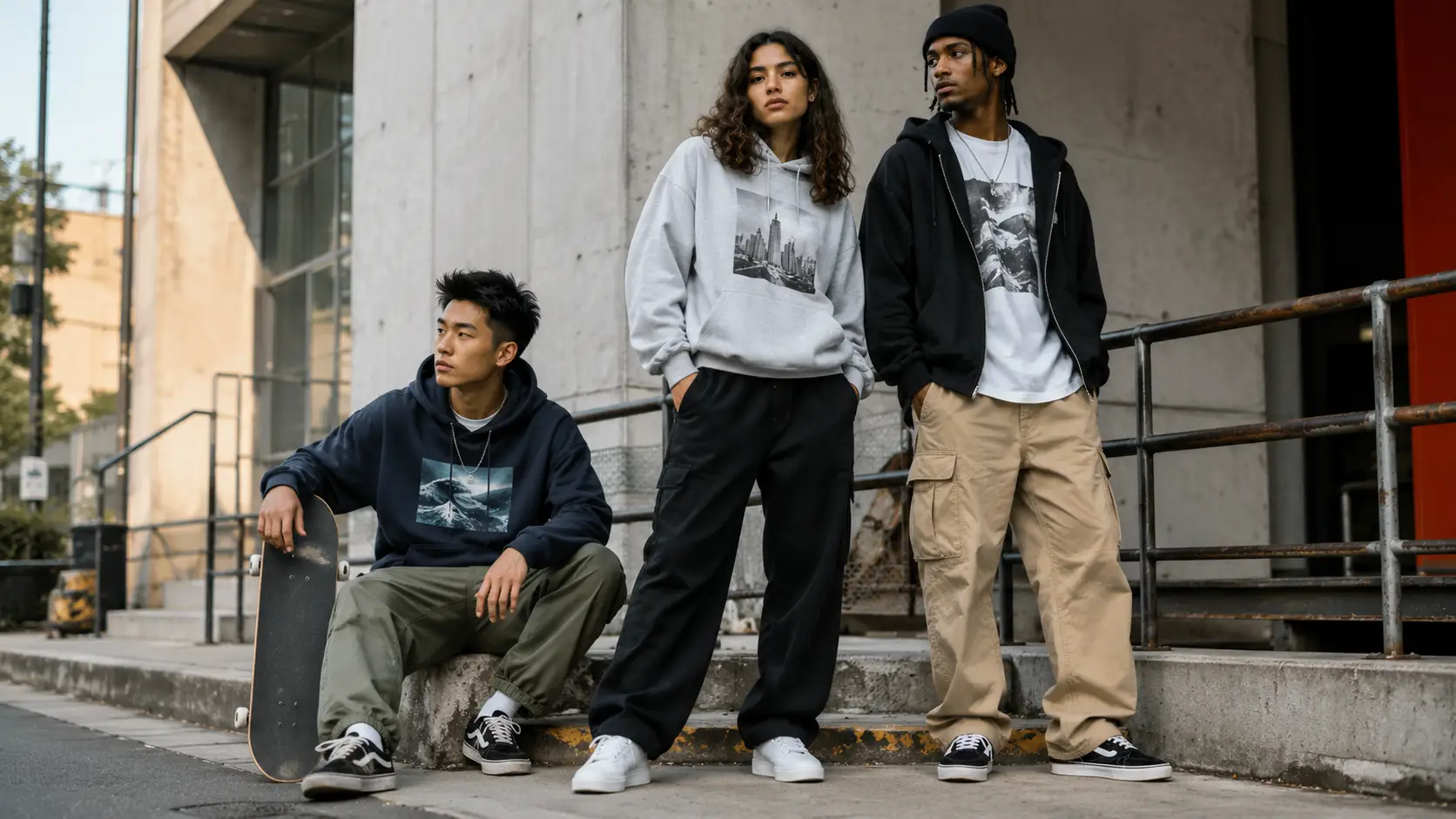
Streetwear is now one of the most recognizable forms of casual fashion, but it did not begin as a mainstream clothing category.

Its roots can be traced through several different cultural movements, including skateboarding, hip hop, surf culture, punk, sportswear, and youth communities that used clothing as a way to express identity. What began as clothing associated with specific groups gradually moved into mainstream fashion and eventually became a major influence on the way people dress every day.
The development of streetwear is interesting because it was not created by a single designer or fashion house. Instead, it grew through communities, music, art, sports, creativity, and changing attitudes toward casual clothing.
Today, graphic T shirts, hoodies, sweatpants, sneakers, matching sets, and relaxed silhouettes are common parts of everyday wardrobes. Understanding how these pieces became so influential provides a better appreciation of modern streetwear.
What Is Streetwear?
Streetwear is a broad term for casual clothing influenced by youth culture, music, sports, art, and urban communities.
There is no single uniform streetwear style.
One person may prefer oversized hoodies and loose sweatpants. Another may combine graphic T shirts with denim and sneakers. Someone else may create outfits around matching sets, athletic clothing, or vintage pieces.
What connects these different approaches is the emphasis on individuality, comfort, casual styling, and cultural expression.
Streetwear also tends to blur the boundaries between clothing categories.
A piece originally associated with sports can become everyday fashion. A graphic T shirt can function as both casual clothing and a form of visual expression. A hoodie can move from athletic environments into social settings.
This flexibility is one of the reasons streetwear has remained relevant for so long.
The Early Influence of Skate Culture
Skateboarding played an important role in the development of modern streetwear.
Skaters needed clothing that allowed movement and could withstand regular physical activity. Loose T shirts, durable trousers, hoodies, sneakers, and other practical garments naturally became part of skate culture.
The clothing was functional, but it also became a way for skaters to communicate their identity.
Graphic designs, logos, and distinctive combinations helped different communities develop recognizable styles.
The influence of skateboarding extended beyond skate parks.
People who were attracted to the culture began adopting the clothing even if they did not participate in the sport. This helped create an early connection between subculture and everyday fashion.
The Influence of Hip Hop
Hip hop had an enormous influence on streetwear.
Music, dance, graffiti, and fashion developed alongside one another, creating a cultural movement where clothing played an important role.
Oversized silhouettes, athletic clothing, graphic designs, sneakers, tracksuits, caps, and other casual pieces became closely associated with hip hop style.
Artists also became influential fashion figures.
Their clothing choices were photographed, discussed, copied, and eventually incorporated into mainstream fashion.
This demonstrated something important about streetwear.
People did not necessarily need formal fashion institutions to decide what looked fashionable. Communities could create their own styles and influence millions of people through music and culture.
Why Graphic T Shirts Became So Important
The graphic T shirt is one of the simplest examples of clothing becoming a form of expression.
A plain T shirt primarily serves a practical purpose.
A graphic T shirt can communicate an interest, attitude, reference, message, or aesthetic.
This made graphic T shirts particularly valuable within youth cultures.
They were relatively simple garments, but the artwork could completely change their meaning.
Today, graphic T shirts remain one of the easiest ways to introduce personality into a casual wardrobe. A carefully selected design can become the focal point of an outfit without requiring complicated styling.
The T shirt collection reflects how this simple garment can function as both an everyday essential and a statement piece.
The Rise of Hoodies in Everyday Fashion
Hoodies have also played a major role in the evolution of casual clothing.
Originally associated with athletic and practical clothing, hoodies eventually became part of numerous youth cultures and streetwear communities.
Their appeal is easy to understand.
They are comfortable, practical, versatile, and suitable for layering.
A hoodie can be worn with sweatpants for a completely relaxed outfit, paired with jeans for contrast, or layered beneath a jacket during colder weather.
Over time, the hoodie became more than functional clothing.
It became a recognizable symbol of casual modern style.
The hoodie collection offers a modern example of how the garment continues to function as an important part of casual wardrobes.
Sneakers Changed the Fashion Conversation
Streetwear cannot be discussed without mentioning sneakers.
Sneakers were originally designed primarily for sports and physical activity. As athletic footwear became more sophisticated, certain models developed cultural significance beyond their original purpose.
Collectors began searching for specific releases. Athletes influenced demand. Musicians incorporated sneakers into their wardrobes. Limited availability created additional interest.
Sneakers eventually became fashion pieces in their own right.
This helped weaken the old distinction between sportswear and everyday clothing.
Today, wearing athletic inspired sneakers with casual clothing is completely ordinary. In many cases, sneakers are one of the most important parts of an outfit.
Streetwear and Sportswear Became Connected
Sportswear has had a lasting impact on streetwear.
Track pants, sweatshirts, jerseys, sneakers, shorts, and other athletic garments gradually became acceptable outside gyms and sporting environments.
People discovered that athletic clothing could provide the comfort they wanted for everyday life.
This shift also changed the expectations people had about casual clothing.
Comfort was no longer considered incompatible with looking fashionable.
Instead, comfort became one of the main qualities people looked for when choosing everyday clothes.
The Role of Music in Fashion
Music has repeatedly influenced streetwear because musicians often become cultural reference points.
When an artist develops a recognizable visual identity, clothing becomes part of that identity.
Fans may adopt similar silhouettes, colors, accessories, or footwear.
This relationship works in both directions.
Musicians influence fashion, while fashion helps musicians communicate their image.
Streetwear became particularly effective in this environment because it offered simple garments that could be customized through graphics, combinations, and accessories.
The Growth of Oversized Clothing
Oversized clothing became another defining characteristic of streetwear.
Larger T shirts, hoodies, sweatshirts, and bottoms create a relaxed silhouette that contrasts with traditional fitted clothing.
The oversized trend also reflects the broader movement toward comfort.
People increasingly wanted clothing that allowed movement and could be worn across multiple environments.
However, oversized clothing is not simply about buying a larger size.
Modern oversized garments are often designed with specific proportions, including wider shoulders, longer sleeves, and adjusted body lengths.
This creates a deliberate silhouette rather than simply making ordinary clothing larger.
Streetwear Became More Accessible
Another important reason for the growth of streetwear is accessibility.
You do not need an extensive wardrobe to participate in the style.
A few T shirts, a hoodie, comfortable bottoms, sneakers, and some accessories can create a large number of combinations.
This makes streetwear appealing to people who prefer practical wardrobes.
It also allows individuals to gradually develop their own style.
Someone can start with basic clothing and introduce graphic pieces as they become more comfortable experimenting.
The Importance of Bottoms
Streetwear discussions often focus heavily on tops, but bottoms have played an equally important role.
Sweatpants, relaxed trousers, shorts, cargo inspired styles, and denim all contribute to the overall silhouette.
The choice of bottoms can dramatically change the appearance of the same hoodie or T shirt.
A graphic T shirt with relaxed sweatpants creates a completely different impression from the same T shirt worn with straight leg trousers.
This versatility is one reason bottoms remain important in modern streetwear wardrobes.
The bottoms collection can be used as a foundation for building different casual combinations.
Relaxed Bottoms
Relaxed bottoms emphasize comfort and create a loose silhouette.
They work naturally with hoodies, oversized T shirts, and casual sneakers.
Structured Bottoms
Straighter or more structured bottoms provide contrast when paired with oversized tops.
This can create a more balanced appearance while still maintaining a streetwear aesthetic.
Women’s Streetwear Expanded the Style Further
Women’s fashion has contributed significantly to the evolution of modern streetwear.
Women have adopted and adapted oversized hoodies, graphic T shirts, sneakers, sweatpants, shorts, cropped pieces, fitted clothing, and coordinated sets.
This has made streetwear increasingly diverse.
Rather than following one standard silhouette, women’s streetwear often combines contrasting proportions.
An oversized hoodie can be paired with fitted bottoms.
A cropped top can be combined with relaxed trousers.
A matching set can provide a coordinated foundation that can then be personalized through footwear and accessories.
The women’s sets collection represents one of the ways coordinated casual clothing fits naturally into modern streetwear.
The Influence of Celebrity Culture
Celebrity culture accelerated the mainstream adoption of streetwear.
When actors, musicians, athletes, and other public figures wore casual clothing in public, those outfits could quickly become widely visible.
Photographs shared through magazines, television, websites, and social media allowed styles to spread faster than ever.
A particular hoodie, sneaker, T shirt, or combination could become recognizable simply because influential people were wearing similar pieces.
This helped streetwear move from specialized communities into everyday wardrobes.
Social Media Changed Streetwear
Social media dramatically changed how fashion trends spread.
Previously, people might discover styles through music videos, magazines, television, or people they encountered locally.
Social platforms created a global visual conversation.
Someone could see an outfit from another country and recreate it almost immediately.
This increased the speed at which trends developed.
It also gave ordinary people the opportunity to influence fashion.
Streetwear became less dependent on traditional fashion authorities because individuals could build audiences around their personal style.
Streetwear and Personal Identity
One of the strongest reasons streetwear continues to matter is its relationship with identity.
Clothing allows people to communicate something about themselves without speaking.
A graphic T shirt can show an interest.
A particular sneaker style can reflect a preference.
A hoodie can communicate a relaxed attitude.
A carefully chosen combination can reflect music, art, sport, or other cultural influences.
This is why streetwear rarely follows one strict formula.
Individual interpretation is part of the style.
The Shift Toward Comfortable Fashion
Modern consumers increasingly expect clothing to provide comfort.
People work from home, travel more casually, spend more time in flexible environments, and move between different activities throughout the day.
This has made comfortable clothing more valuable.
Streetwear was already built around many of these qualities.
Hoodies, T shirts, sweatpants, sneakers, and matching sets can transition between multiple activities without requiring a complete outfit change.
The popularity of these garments therefore reflects broader changes in everyday lifestyles.
Streetwear Is No Longer Limited to the Street
The name might suggest a specific environment, but streetwear is now worn almost everywhere.
People wear graphic T shirts to casual dinners.
Hoodies appear in airports and offices with relaxed dress codes.
Sneakers are common at restaurants, shopping centers, and social events.
Sweatpants have moved beyond home environments and become acceptable everyday clothing.
This does not mean traditional fashion has disappeared.
Instead, the boundaries between formal, casual, athletic, and streetwear clothing have become less rigid.
How to Build a Modern Streetwear Wardrobe
Understanding the history of streetwear can help when building a wardrobe today.
You do not need to copy a particular decade or subculture.
Instead, take inspiration from different elements.
Start with versatile basics.
Add a few graphic T shirts for personality.
Choose one or two hoodies that work with your existing clothing.
Include comfortable bottoms in different silhouettes.
Add sneakers that can work across multiple outfits.
Then experiment with accessories, layering, and color.
The Leo Skepi Merch homepage provides another place to explore casual pieces that can be incorporated into this type of wardrobe.
Keep Your Wardrobe Flexible
The most useful streetwear pieces are those that can be worn in several combinations.
A T shirt that works with three different bottoms is more versatile than one that only matches a single outfit.
A hoodie that can be worn over multiple tops gives you more options.
Matching sets can also be separated so that each piece contributes to different outfits.
Flexibility allows you to create variety without buying excessive amounts of clothing.
The Future of Streetwear
Streetwear continues to evolve because it is influenced by culture rather than a single fashion rule.
New generations reinterpret older styles.
Music continues to influence clothing.
Sports continue to introduce new silhouettes.
Social media continues to accelerate trends.
Designers continue to experiment with materials, proportions, and graphics.
At the same time, consumers continue to value comfort and individuality.
These factors suggest that streetwear will continue changing rather than settling into one permanent definition.
The specific pieces may change, but the underlying ideas of self expression, community, comfort, and creativity are likely to remain important.
Final Thoughts
The history of streetwear is really a history of cultural influence.
Skateboarding introduced practical clothing and distinctive community style. Hip hop demonstrated how music and fashion could develop together. Sportswear brought athletic clothing into everyday life. Sneakers became cultural objects rather than simply athletic footwear. Graphic T shirts turned simple garments into forms of expression.
Hoodies, relaxed bottoms, matching sets, and oversized silhouettes later became part of an increasingly flexible approach to dressing.
What makes streetwear different from many traditional fashion movements is that it was shaped by people and communities rather than following one central path.
It continues to change because people continue to reinterpret it.
Today, you can build a streetwear wardrobe around a few simple pieces or create a highly individual collection filled with distinctive graphics, colors, silhouettes, and accessories.
There is no requirement to follow one exact formula.
The most important part is understanding why certain pieces appeal to you and using them to create a style that feels natural.
That freedom is ultimately what has allowed streetwear to move from specific subcultures into everyday fashion while continuing to feel personal, expressive, and relevant.